The Compatibility Atlas:
A Convex‑Geometric Index for LoRA Libraries
\(N_d\) designs, once
\(\{\widehat q_t\}_{t=1}^{n}\)
\(\min_{c}\max_{t\in T}\widehat q_t(c)\)
\((c^\star,\lambda^\star,\text{cores})\)
| Reusable atlas | Result |
|---|---|
| Mistral index: 16 adapters, 136 calibration merges | 0.96 Pearson on 120 off-design triples |
| Mistral index: 50 adapters, 1,275 calibration merges | 0.95 AUROC on 1,096 pair/triple queries |
| Local Qwen screen, 20% validation budget | 45.5% recall, 77.6% precision, 73% compute saved |
Abstract
LoRA adapters merge into one model at low cost, but a fifty-adapter library already yields more than two million five-way subsets, too many for exhaustive held-out validation. We fix the base model, merge rule, allowed merge weights, evaluation prompts, and the tokens on which the loss is scored, then fit a quadratic model of each task’s loss in the merge weights. Each query names adapters to combine and tasks to retain; a small convex optimization over the fitted models returns the verdict and a surrogate certificate for it, with no further evaluation of the merged model; certifying the deployed loss itself additionally requires uniform approximation envelopes, which we measure on finite designs rather than establish over the whole chart. The per-library record of these verdicts is the Compatibility Atlas. By Helly’s theorem, any rejection of the fitted models is forced by at most \(d{+}1\) tasks; by Carathéodory’s theorem, an accepted merge places its free weight on at most \(d{+}1\) adapters, where \(d\) is the number of free merge weights; and for \(d\ge2\), checking every pair at a fixed threshold is not enough to decide every triple. One fit on sixteen adapters, using the loss on answer tokens, predicts the measured loss of 120 off-design three-adapter merges at Pearson correlation 0.96 (bootstrap interval \([0.75,0.98]\)); under linear merging, one fit on fifty screens 1,096 pair and triple merges at AUROC 0.95. On a separate library of fifty adapters and four merge methods, the locally fitted score recovers 45.5% of the merges that pass held-out retention validation at 78% precision, using 27% of the exhaustive validation cost.
The method
Given a library of LoRA adapters trained on the same base, exhaustively validating every candidate merge on held-out data is expensive, since a fifty-adapter library already has \(\binom{50}{5}=2{,}118{,}760\) five-way candidates. Our running example is a Qwen2.5-0.5B-Instruct base with a Hugging Face PEFT library of fifty LoRA adapters spanning instruction following, code generation, GSM8K-style math, SQL writing, summarization, refusal training, and multi-turn chat. Many merge operators exist, among them weight averaging, task arithmetic, TIES (trim, elect sign, and merge), and variants of DARE (drop and rescale), and all of them assume the subset has already been chosen. We ask which subsets are worth validating.
A concrete query from this library asks whether the math, SQL, and summarization adapters can be merged, each with weight at least 0.2, so that the math and SQL tasks keep their single-adapter performance.
Every certificate in this paper is a surrogate certificate, a guarantee about the fitted convex models; upgrading it to a deployed-loss certificate, a guarantee about the model that is actually served, requires uniform approximation envelopes over the query chart, which we measure on finite designs but do not establish uniformly. The per-library record of verdicts is the Compatibility Atlas.
Our contributions:
- A surrogate-certified convex screen. Sion duality gives every verdict a checkable primal–dual certificate, and supplying approximation envelopes upgrades it to a sound accept/reject/inconclusive test for the deployed loss.
- Two-sided finite cores. Rejection is forced by at most \(d{+}1\) protected tasks (Helly) and an accepted merge places its free weight on at most \(d{+}1\) adapters (Carathéodory), the two cores forming a discrete saddle; a shared rank \(r\) lowers both orders to \(r{+}1\).
- Pairwise impossibility. For \(d\ge2\) no thresholded pairwise compatibility graph decides every triple; the disagreements occur in practice.
- Evidence at library scale. We validate atlas indexes fitted once at sixteen to fifty adapters, a four-operator screening run, and deployed coefficient interventions.
Compatibility queries over tasks and adapters
A query fixes the adapters \(U\subseteq[m]\) allowed in the merge, the tasks \(T\subseteq[n]\) it must retain, and a coefficient floor \(\ell\in\mathbb{R}^m_{\ge0}\) supported on \(U\) with \(\|\ell\|_1\le1\); the free mass is \(s_\ell:=1-\|\ell\|_1\). The merge chart is the simplex on \(U\) raised above the floor, \(C(U,\ell)=\{\ell+s_\ell z:z\in\Delta_U\}\subseteq\mathbb{R}^m\), a compact convex chart of intrinsic affine dimension \(|U|{-}1\) when \(s_\ell>0\); when \(s_\ell=0\) it is the single point \(\ell\).
For a protected-task subset \(S\subseteq[n]\), define the minimax retention score \[\rho_S(C)=\min_{c\in C}\max_{t\in S}q_t(c).\] The subset is compatible at threshold \(\tau\) iff \(\rho_S(C)\le\tau\).
Effective dimension and the atlas as an index
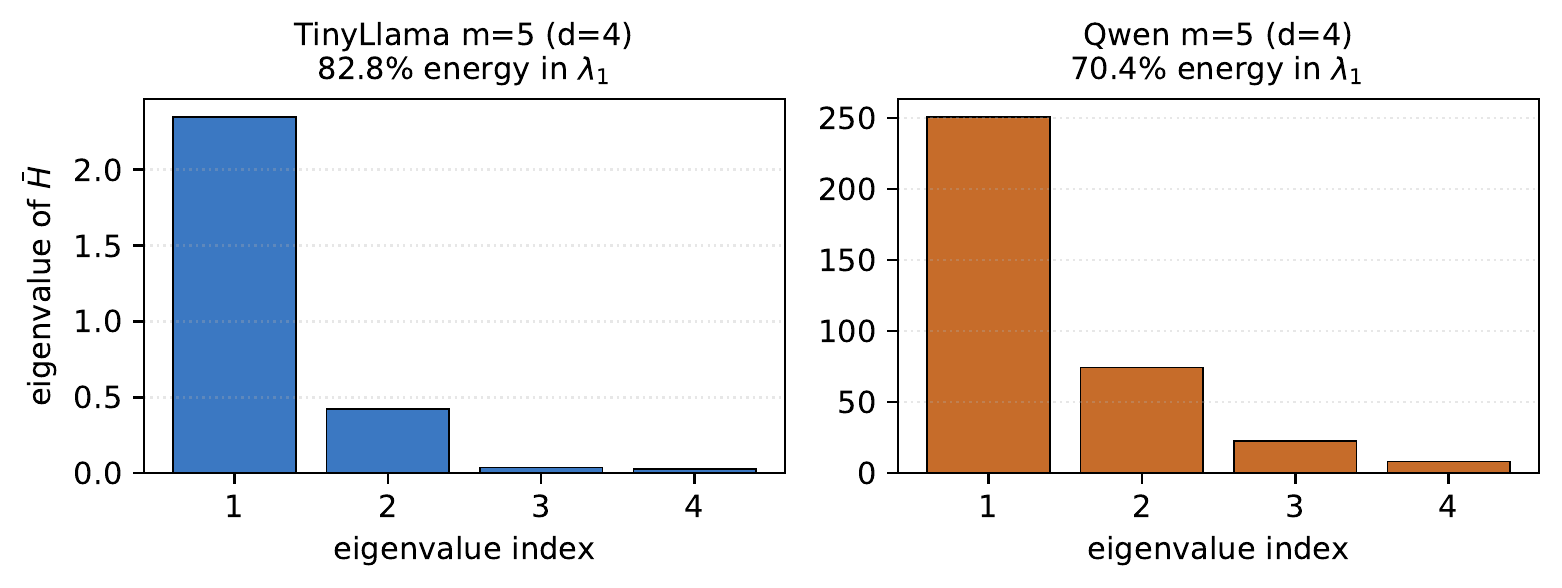
If the task models share an \(r\)-dimensional representation, both core bounds improve from \(d{+}1\) to \(r{+}1\), and the order is tight; the minimal such \(r\) is exactly the rank \(r_{\mathrm{exact}}(C)\) of an intrinsic curvature matrix computed in the chart’s own coordinates, and a factorization holding only within a uniform error \(\delta\) moves every score by at most \(2\delta\). As a computable diagnostic, the mean-Hessian projector residual certifies an upper bound on the spectral effective dimension \(\sigma\text{-}\mathrm{adim}_\epsilon\), the smallest rank at which any projector’s strict per-task residual falls below \(\epsilon\).
On a shared \(m\)-adapter simplex with design step \(\tfrac12\), the poised quadratic design (poised: the losses measured at its points determine the quadratic’s coefficients uniquely) consists of all single adapters and all equal-weight pairs; this is Scheffé’s quadratic simplex-lattice design \(\{m,2\}\), the classical saturated design for quadratic response surfaces on a mixture simplex. At \(d=m{-}1\) this gives \(N_d=m+\binom{m}{2}\) design merges, so building the fifty-adapter atlas takes one pass over 50 singles and 1,225 equal-weight pairs. Every later query is a convex minimax over the fitted quadratics; on a laptop CPU core the released solver answers one in 13 to 46 milliseconds on the \(m{=}8\) charts and at a median of 0.46 seconds for a five-way query at \(d{=}49\).
Experiments
Exhaustive validation is expensive at \(m{=}16\): the \(\binom{16}{3}{=}560\) triples cost hours to validate while one 136-point build scores them all and every higher order, with fidelity 0.96 on 120 independently evaluated off-design triples and screening AUROC 0.99.
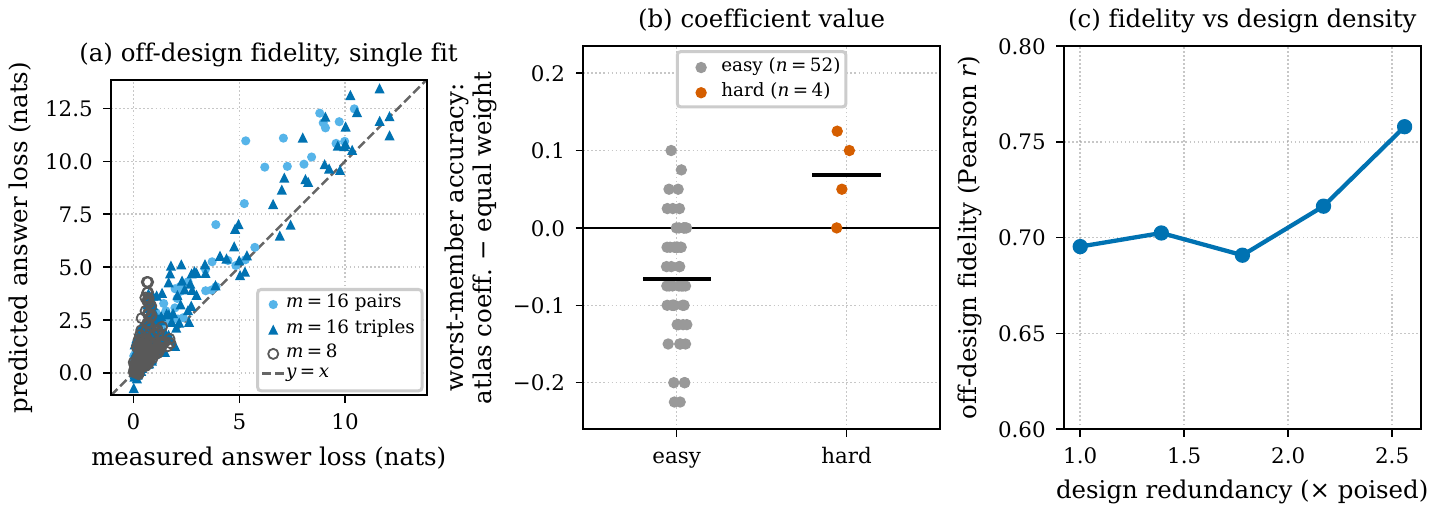
The same construction extends to thirty and fifty adapters on the same Mistral-7B base. Each build fits the singles-and-pairs design once (465 and 1,275 design merges) and answers every subset query on its faces; validation covers every pair plus sampled triples, 443 and 1,096 subsets with every member scored. At the 70% retention threshold the screen gives AUROC 0.94 at \(m{=}30\) and 0.95 at \(m{=}50\) (bootstrap intervals \([0.87,0.99]\) and \([0.89,0.98]\); triples alone 0.93 and 0.94), and pooled fidelity on off-design triples is 0.86 and 0.85.
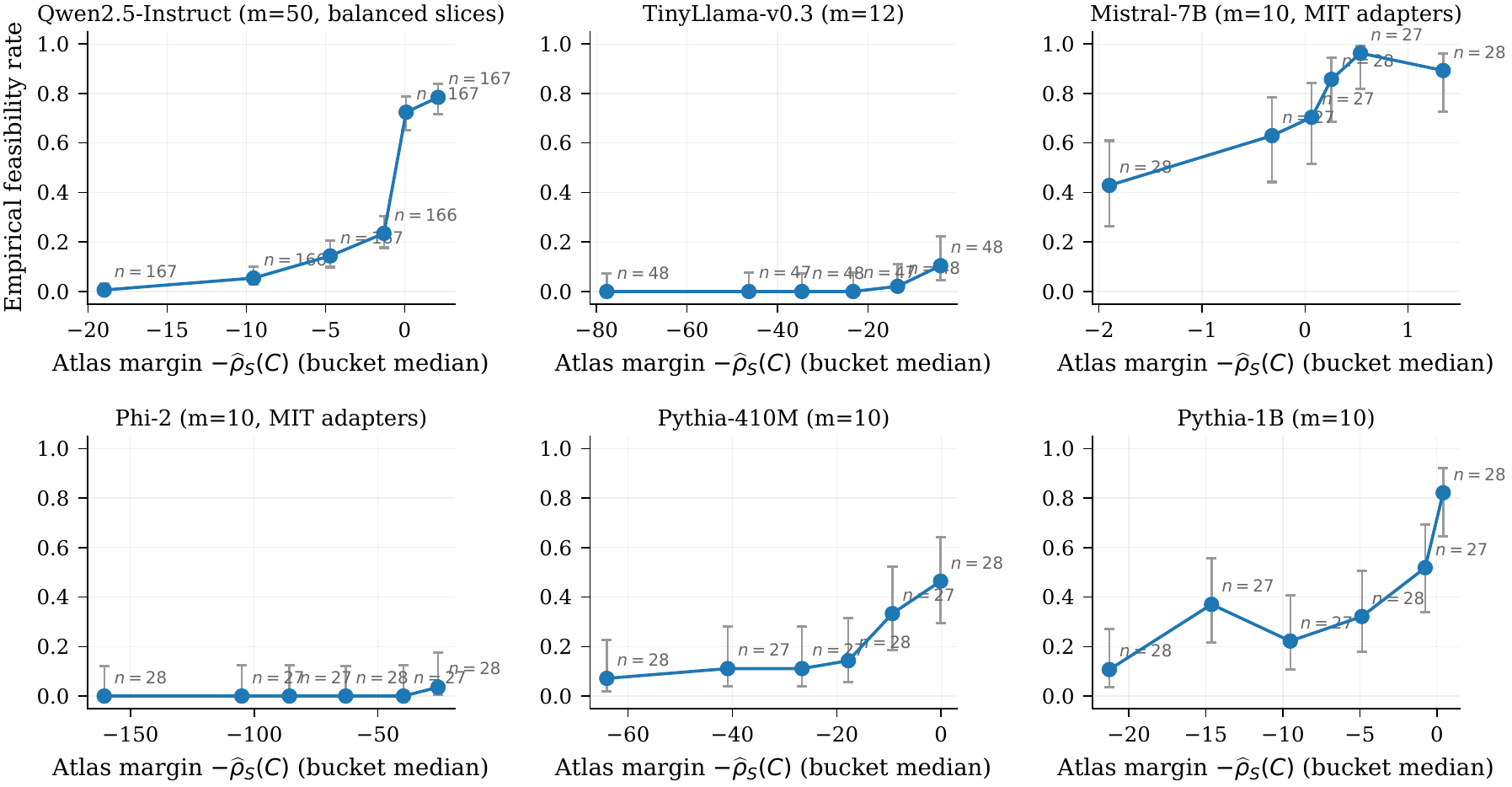
The released public panel totals 7,784 evaluated pair/triple records: Qwen2.5 \(m{=}50\) balanced/circulant slices plus full pair/triple enumeration for TinyLlama \(m{=}12\) and Mistral, Phi-2, Pythia-410M, and Pythia-1B \(m{=}10\) panels.
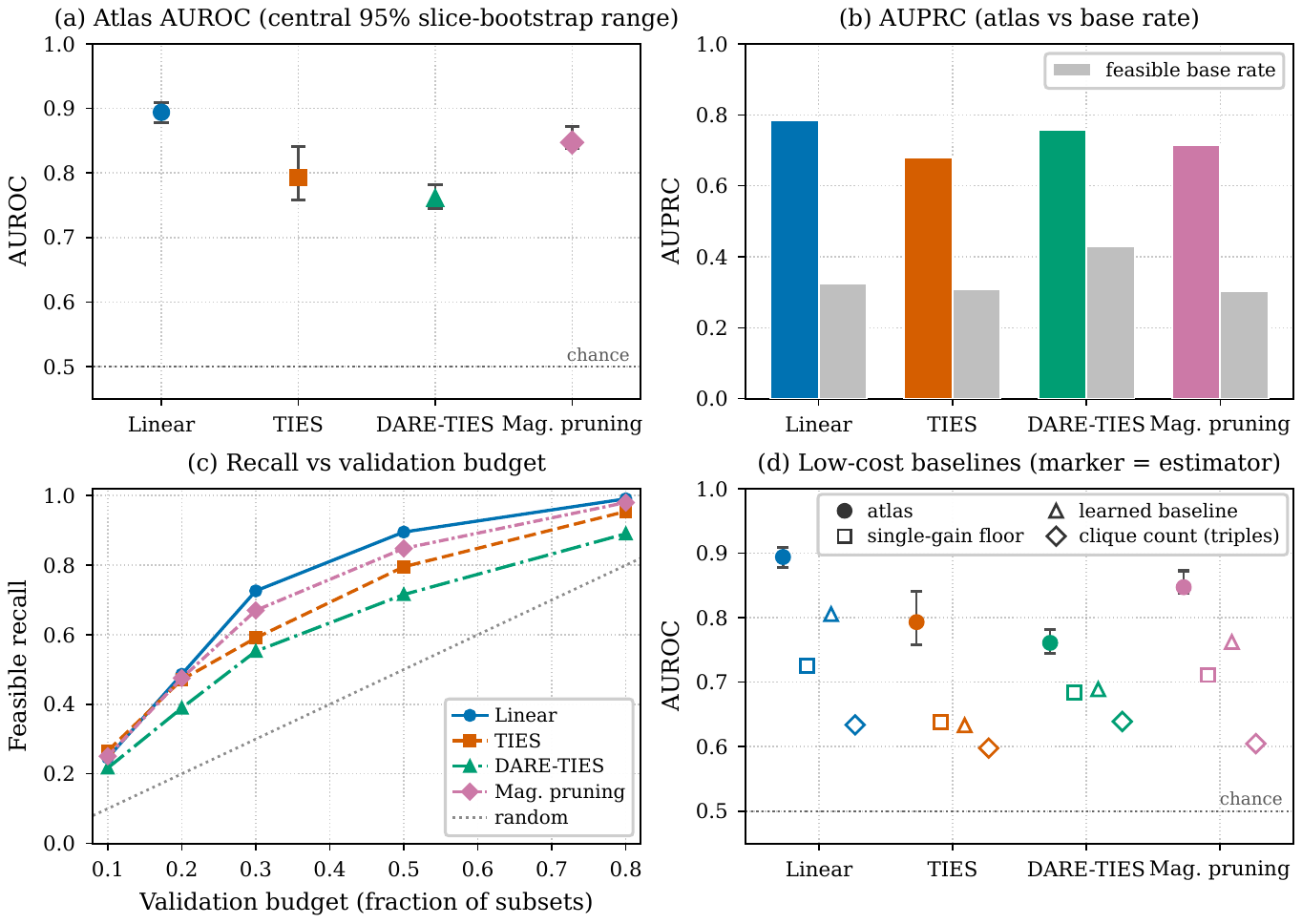
At a 20% validation budget (full validation \(\approx 33\) MI300X-hours), validating the atlas’s top-\(k\) recovers 45.5% of the subsets that pass held-out validation at 77.6% precision and saves 73% of the GPU-hours including the \(\sim\)2 s per-query screening cost (adapter-resampling bootstrap: recall \([34.2,59.6]\%\), precision \([60.8,91.3]\%\)).
Atlas screening outperforms the label-free low-cost screens on Qwen, at per-operator AUROC 0.76 to 0.89 versus 0.64 to 0.73 for a single-adapter calibration-gain floor and 0.63 to 0.81 for leave-one-slice-out logistic regression, and cosine baselines on raw \((B,A)\) and on \(\Delta W{=}BA\) trail it by at least 25 AUROC points.
Limitations
Every certificate we report is a surrogate certificate: exact for the fitted task models, and silent about the deployed loss until envelopes are supplied. Decisions about the deployed loss additionally require uniform approximation envelopes over the continuous chart; these remain unestimated. Finite-design versions are evaluated on six dense charts, while the larger panels’ certificates remain statements about the fitted models, and the deployed tests of coefficient selection cover sixteen queries in total.
Code and data
The screening runner, the analysis scripts, and every released result are at github.com/sushaan-k/lora-compatibility-atlas. Running verify.py there recomputes the paper’s headline numbers from the released records and checks them against the values printed here.
Citation
@misc{kandukoori2026compatibilityatlas,
  title  = {The Compatibility Atlas: A Convex-Geometric
            Index for {LoRA} Libraries},
  author = {Kandukoori, Sushaan and Atreja, Aarit and
            Brahmbhatt, Devom and Parvathareddy, Avaneesh
            and Filkov, Vladimir},
  year   = {2026},
  url    = {https://github.com/sushaan-k/lora-compatibility-atlas}
}